GHK-Cu for Skin: My Topical Routine

The important question around FormBlends is practical: what is actually known, what remains uncertain, and what safeguards a licensed clinician and pharmacy process add before anyone treats it as an option.
Last October, my friend Rachel in Portland pulled up two photos on her phone at dinner. Same bathroom mirror, same overhead light, twelve months apart. “I know the lighting thing sounds crazy,” she said, “but I take these every Sunday at 7 a.m. before I put anything on.” The difference was subtle but undeniable: less crepe-paper texture around the eyes, more evenness through the cheeks, something that read as density more than smoothness. She’d been on a compounded GHK-Cu serum the entire time. I’d been on mine for about eight months at that point. We compared notes for an hour.
This is a year of GHK-Cu on my face, distilled into a routine that stopped changing eight months ago because it stopped being interesting once I found what works. In short, copper peptide serum, applied morning and night, layered between specific other actives, has been the single most visible skin intervention I’ve made in my forties.
The required compliance note: GHK-Cu (copper tripeptide-1) is used as a cosmetic ingredient in many over-the-counter formulations and as a compounded research peptide for prescribed use. The compounded versions discussed here are prepared by licensed 503A pharmacies for individual prescriptions based on prescriber clinical judgment. Topical cosmetic products are not subject to FDA pre-market approval. None of what I write is medical advice.
A quick primer on the molecule
GHK-Cu is a small tripeptide (glycyl-histidyl-lysine) bound to a copper ion. It occurs naturally in human plasma, with levels declining significantly after age 40. The published research on topical applications goes back to the 1980s and shows effects on collagen synthesis, fibroblast activity, antioxidant function, and skin barrier repair. As peptides go, this one has a legitimately deep bibliography in dermatology.
Think of it as occupying the same conceptual shelf as retinoids and certain growth factor serums: actives that drive collagen turnover and improve skin density. The mechanism is different, though. And that difference turns out to matter, because GHK-Cu appears to do something additive rather than redundant alongside tretinoin. More on that below.
How I ended up here
I’m 47. I’d been on a tretinoin routine for about two years, with good but clearly plateauing results. A dermatologist friend (not my treating derm) mentioned she’d been adding copper peptide serums into her own routine and seeing collagen and density improvement beyond what tretinoin alone gave her.
I asked my actual dermatologist about it. She knew the research, was supportive of trying it, and laid out two paths. One: over-the-counter GHK-Cu serums, which vary wildly in concentration and formulation quality. Two: a compounded prescription serum at a specified concentration. We went with the compounded route because we wanted a known concentration and a known carrier. No guessing.
The product specifics
Here’s what I use:
- Compounded GHK-Cu serum at 2 percent in a hyaluronic acid base
- pH adjusted to about 6.5, which is in the range where GHK-Cu is most stable
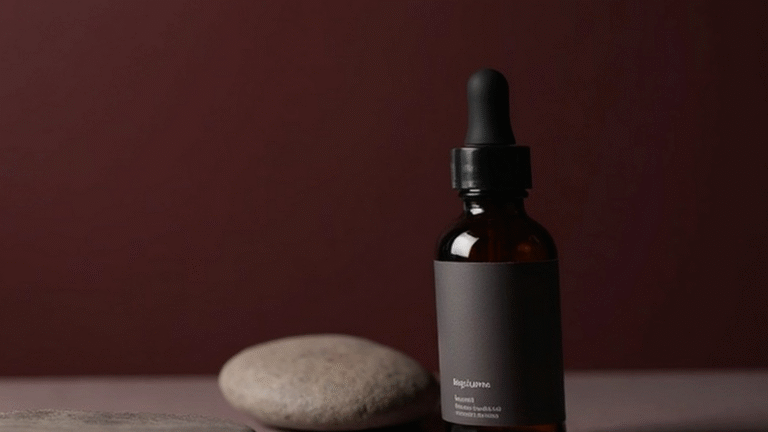
- Dispensed in 30 mL amber glass with a dropper
- Beyond-use date of 90 days from compounding
- Stored in the refrigerator after opening, brought to room temperature before application
The compounded version costs about $80 per 30 mL, which lasts me roughly 6 weeks at the volume I apply.
The actual routine, morning and night
Morning:
- Gentle cleanser
- GHK-Cu serum, 3 drops, pressed into damp skin
- Wait 2 to 3 minutes
- Vitamin C serum (separate active, applied after, never mixed)
- Wait 2 to 3 minutes
- Moisturizer
- Sunscreen (SPF 50 mineral, non-negotiable)
Evening, alternating nights with tretinoin:
GHK-Cu nights:
- Double cleanse if I wore sunscreen
- GHK-Cu serum, 4 drops, pressed into damp skin
- Wait 5 minutes
- Niacinamide serum
- Moisturizer
Tretinoin nights:
- Cleanse
- Wait 20 minutes for skin to dry completely
- Tretinoin 0.05 percent
- Wait 20 minutes
- Heavy moisturizer
- No GHK-Cu
I keep GHK-Cu and tretinoin on separate nights. Not because of a known interaction, but because I wanted to evaluate each active on its own terms. After eight months I’m confident the combination produces additive results, but the alternation pattern works for my skin and I see no reason to change it.
The timeline, honestly
Months 1 to 2. Almost nothing visible. Skin felt slightly softer in the mornings. I suspected placebo. I almost quit.
Months 3 to 4. First real change. Fine lines around my eyes looked softer. I take side-lighting photos every Sunday morning at the same time (Rachel and I stole the idea from each other, apparently). The week-over-week changes were invisible. The month-over-month changes were not.
Months 5 to 7. This is when other people started commenting. My mother noticed at a family event. A coworker asked what I was doing. Skin looked more even-toned, less crepey around the eyes and lower neck. The undereye darkness improved, which I genuinely wasn’t expecting.
Months 8 to 12. Steady state. Continued, slower improvements. The cumulative effect at 12 months is meaningful but not dramatic. I look like a slightly better-rested version of my own face. Not a younger person’s face. I think that distinction is important, and I think it’s the honest thing to say.
Mistakes I made so you don’t have to
Mixing GHK-Cu and vitamin C together. Don’t. The copper interacts with ascorbic acid in ways that can degrade both actives. Apply them in sequence with a few minutes between.
Layering GHK-Cu directly onto fresh tretinoin. The first time I tried this my skin reacted with real irritation. Not catastrophic, but the combination on damp skin was too much for me. That’s when I committed to the alternating-night schedule.
Swapping in a cheaper OTC serum during a travel week. The product had a higher pH and felt different on the skin. I don’t have data on whether it was less effective, but I went back to the compounded version the day I got home.
Letting a bottle go past its beyond-use date. The serum changed color slightly. I threw it out and reordered. Copper peptide complexes degrade, and the color change is the visible warning sign. Don’t talk yourself into using it anyway.
What GHK-Cu hasn’t done
It hasn’t erased the lines I have. The improvements are in texture, tone, and apparent density. The structural lines from decades of facial expression? Still there. Just slightly softer.
It hasn’t replaced tretinoin. I dropped the retinoid briefly as an experiment. Bad idea. The two seem to work on different axes of skin biology, and removing either one showed me the other was doing meaningful, distinct work.
It hasn’t given me younger skin. Here’s my genuinely held opinion on this: any product that promises to make you look ten years younger is lying to you. GHK-Cu has given me 47-year-old skin that looks like it belongs to a 47-year-old who pays attention. That’s the realistic ceiling, and honestly, it’s enough.
Where I source it
I work through my dermatologist for the prescription and the compounding pharmacy fulfillment. The current lot is dispensed through a 503A pharmacy in the FormBlends network, which is where her practice routes compounded GHK-Cu prescriptions for patients who want the controlled-concentration version. There are other 503A pharmacies that compound the same formulation. The right one is whichever your prescriber trusts to maintain pH and concentration consistency from lot to lot.
I don’t recommend buying topical GHK-Cu from unverified online sources. The concentration claims on labels often don’t match the actual product, and the carrier formulations can affect penetration significantly. This is one of those categories where the boring, prescription-routed option is genuinely worth the extra friction.
The things I still don’t know
I don’t know what the trajectory looks like at year 3 or year 5. I don’t know whether the gains eventually plateau to the point where I’m paying for skincare that produces no additional measurable benefit. I don’t know whether stopping for an extended period would cause the improvements to revert. I haven’t run those experiments because the routine is working and I don’t want to disrupt it just to satisfy my curiosity.
What I do know is that the year-one results were enough to keep me on the protocol. For someone deciding whether to try it, that’s the data point that matters. Not the mechanism-of-action studies, not the before-and-after photos on Reddit. Whether someone with similar skin, similar age, and similar expectations found it worth the money and the daily discipline eight months in. I did.
Frequently Asked Questions
Is GHK-Cu safe for sensitive skin? In general, yes. The molecule is naturally present in human plasma, and at the 1 to 2 percent concentrations typically used in topical formulations, irritation is uncommon. That said, the carrier matters a lot. If the base contains fragrances or known irritants, your sensitivity may have nothing to do with the peptide itself. Patch test any new formulation behind the ear for 48 hours before putting it on your face.
Can I use GHK-Cu and retinol at the same time? You can, but I’d stagger them on alternating nights rather than layering them in the same session. The combination isn’t dangerous, but both actives benefit from clean, direct contact with the skin. Piling them together increases the chance of irritation without clear evidence that simultaneous application improves results.
How long does it take to see results from topical GHK-Cu? In my experience, visible changes took about three months to become apparent in my weekly photos. Don’t expect anything meaningful in the first four to six weeks. Collagen remodeling is slow biology, not fast cosmetics.
What concentration of GHK-Cu should I look for? Most of the published research and clinical formulations use concentrations between 1 and 2 percent. Higher isn’t necessarily better. Stability, pH, and the carrier formulation matter as much as raw concentration, possibly more.
Does GHK-Cu replace retinoids? No. Based on my experience and the available research, they appear to work through different biological pathways. GHK-Cu seems to complement retinoid therapy rather than substitute for it. If you’re already on tretinoin and happy with the results, think of copper peptide as an addition, not a replacement.
Do I need a prescription for GHK-Cu? Not necessarily. Many OTC serums contain GHK-Cu as a cosmetic ingredient. The compounded prescription route gives you a specified concentration and a controlled formulation, which is why I chose it. But the OTC options are available without a prescription.
Should I store GHK-Cu in the refrigerator? For the compounded version I use, yes. Refrigeration helps maintain stability over the 90-day beyond-use window. OTC products may have different stability profiles depending on their preservative systems. Check the label, but when in doubt, refrigerate.
Cosmetic and compounded GHK-Cu is not FDA-approved for any therapeutic indication. Compounded formulations are prepared by licensed pharmacies for individual prescriptions based on clinical judgment. Personal experience, not medical advice.